Scope
How "mine/ours" feelings affect commitment
School of Business and Management · Research Dossier
Plain-language research synthesis · Organizational behaviorIn simple terms, psychological ownership is the feeling that something is "mine" or "ours" even without legal ownership. This page explains how that feeling connects to commitment at work.
Abstract
This report summarizes peer-reviewed studies and clearly separates what is strongly supported from what is still uncertain in the UEH model.
Scope
How "mine/ours" feelings affect commitment
What is solid
Peer-reviewed findings with links
What is missing
No public UEH structural equation model (SEM) coefficients yet
Newcomer guide
Start HerePsychological ownership is a feeling, not a legal contract. People feel ownership when they can shape work, understand it deeply, and see it as part of who they are.
"Mine"
I feel personal responsibility and control.
"Ours"
Our team feels shared responsibility.
Why it matters
Higher ownership often aligns with stronger commitment.
Simple example
A team designs a process and then protects and improves it.
Quick tip: when reading this page, map each result to either individual ownership ("mine"), collective ownership ("ours"), or commitment outcomes.
Verification protocol
Research Integrity CheckPrior studies support the ownership-commitment link. However, UEH model outputs (sample, fit, and coefficients) are not publicly available, so UEH-specific effect sizes are still unconfirmed.
Validated Window
2001 to 2025 literature
Core Constructs
Individual + collective ownership
Supported Link
Ownership is linked with commitment attitudes
Unverified Item
Study-level effect size values
Evidence note: online figures below are from published studies, not UEH coefficients.
Literature evidence matrix
Evidence CheckStrong evidence
Researchers have used this concept reliably for many years across organizational settings.
Pierce, Kostova, & Dirks (2001)Strong evidence
When people feel "this is my work," they tend to report stronger commitment and engagement.
Van Dyne & Pierce (2004)Moderate evidence
Ownership can raise emotional commitment, but the strength of the effect changes by context.
Bernhard & O'Driscoll (2003)Emerging evidence
The "ours" pathway is conceptually strong, but needs more direct testing in field data.
Pierce, Lee, & Li (2025, in press)Applied context review
Industry SignalRecent workplace data shows a persistent engagement gap. This is where ownership-focused interventions are often most useful.
31%
Gallup reports 31% of U.S. employees engaged in 2025 (unchanged from 2024).
View source21%
Gallup shows worldwide engagement declined to 21% in 2024, only the second annual drop in 12 years.
View source$438B
Gallup estimates low engagement cost the global economy $438 billion in lost productivity in 2024.
View source6,609
The U.S. had 6,609 ESOPs with 15.1M participants and over $2T in assets in the latest benchmark.
View sourcePublished figure audit
Online Figures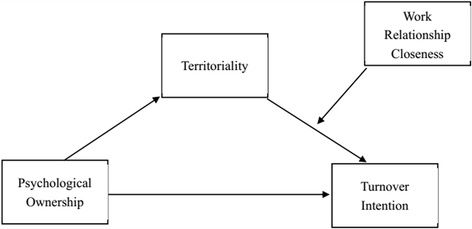
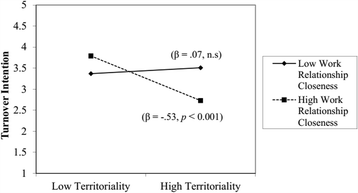
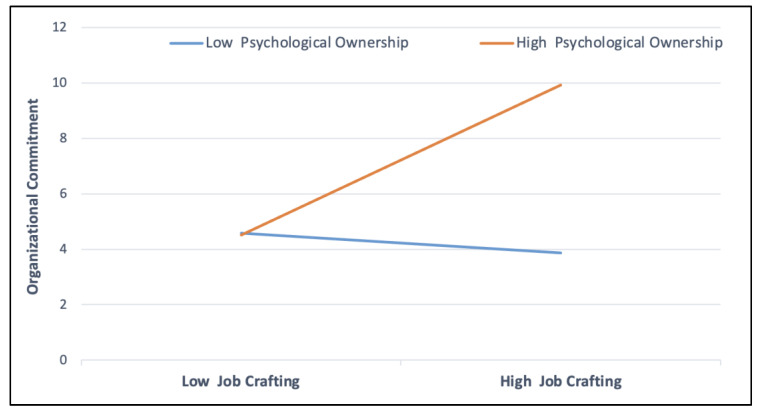
Sample
n = 341 (Tong et al., 2017)
Interaction slope
beta = -0.53, p < .001
Sample
n = 457 (Wang et al., 2025)
Moderation effect
beta = 0.17, p < .001
Decision guidance
3 Quick ActionsBibliography
Verification SourcesValidated on February 24, 2026.
Scope note: figures in the Online Figures section are directly sourced from published papers.