Back to All Research
Influencer marketing lab | plain-language summary | SEM

Influencer Marketing Lab: Retention Signals on UGC Platforms

This study asks a practical question: what makes audiences return after seeing influencer content? It combines survey evidence with public creator examples to turn model results into clear campaign actions.

n = 565 active UGC users in Vietnam Methods: EFA, CFA, and SEM Goal: improve repeat engagement and retention
Start Here

What this page means if you are new to the topic

This research focuses on one question: after people see influencer content, what most strongly predicts whether they stay engaged and come back?

Question and data scope

  • Main question: Which factors are strongest predictors of retention in influencer campaigns?
  • Data source: Survey data from 565 active UGC users in Vietnam.
  • Scope boundary: This model explains patterns in this dataset, not all markets.

How to read the reported numbers

  • R2 55% (engagement): the model explains about half of engagement differences.
  • R2 70% (retention): the model explains most retention differences in this sample.
  • Interpretation: these are relationship signals that guide decisions, not final causal proof.

Glossary: construct labels

  • CX: content experience quality.
  • CEX: expectation match between message and delivered value.
  • BE: brand equity transfer from creator trust.
  • CE: consumer engagement quality (depth of interaction).
  • CR: customer retention (return intention or repeat behavior).

Glossary: method labels

  • UGC: user-generated content.
  • EFA: exploratory factor analysis (finds structure).
  • CFA: confirmatory factor analysis (tests structure).
  • SEM: structural equation modeling (tests relationships).
  • R2: percent of outcome variance explained by the model.
Core Finding

Retention depends on engagement quality

In this model, reach alone is not enough. The strongest bridge to retention is high-quality engagement after first exposure.

Sample size

565 respondents

Exploration sample (EFA)

200 cases

Validation sample (CFA/SEM)

365 cases

Engagement model fit (R2)

55% explained

Retention model fit (R2)

70% explained

Evidence status: Sample size, split-sample counts (200/365), and R2 values are taken from local FCBEM 2025 manuscript screenshots in the Documents research archive. A public proceedings or DOI link is not attached on this page yet.

Creator Cases

Public creator examples that explain the model

These public YouTube cases are explanation examples for the Four-E model. They are not observations inside the n = 565 survey dataset.

Khoai Lang Thang travel storytelling video thumbnail used as influencer marketing case benchmark

Khoai Lang Thang

Story-driven travel creator

Primary Four-E mapping: CX + CE

Episodic place-based storytelling builds stronger content experience, and audience dialogue helps keep engagement active between videos.

Source video
Vo Ha Linh affiliate review video thumbnail used as influencer marketing case benchmark

Vo Ha Linh

Review commerce influencer

Primary Four-E mapping: CEX + CE

Clear affiliate disclosure helps align expectations before purchase and supports structured engagement around product comparison.

Source video
Hannah Olala brand collaboration travel story video thumbnail used as influencer marketing case benchmark

Hannah Olala

Beauty and lifestyle influencer

Primary Four-E mapping: BE + CX

Brand-collaboration storytelling shows how creator trust can transfer to the brand and support stronger return behavior.

Source video
Evidence Pair

What the model found and how to use it

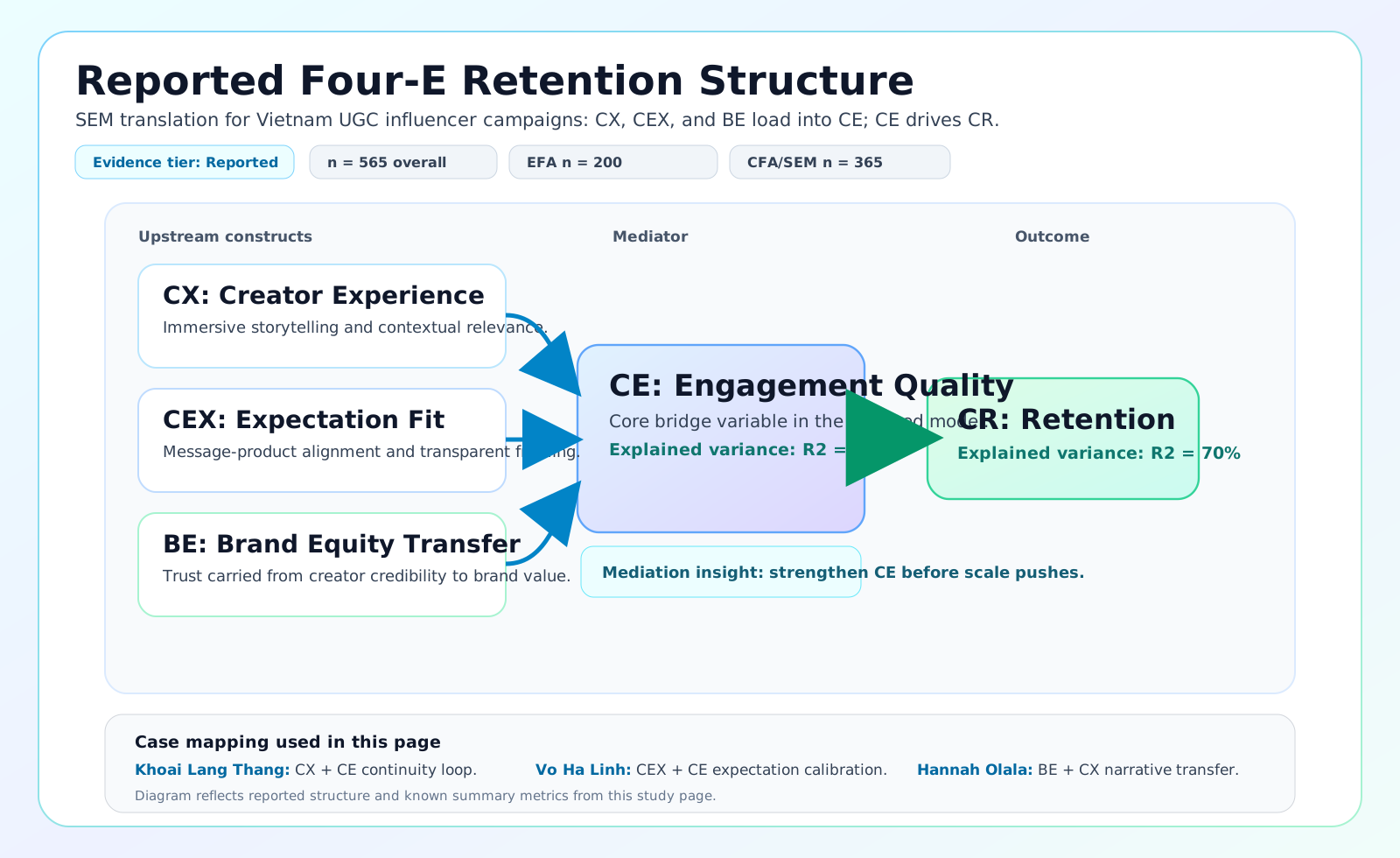
Reported Four-E SEM model where CX CEX and BE feed engagement quality and engagement drives retention with model variance context

Reported structure: CX, CEX, and BE improve CE (engagement quality), and CE is the direct bridge to CR (retention).

Reported values: CE model R2 = 55% and CR model R2 = 70% in the reported sample (n = 565).

Left figure is the reported model view tied to this page's construct names and sample split.
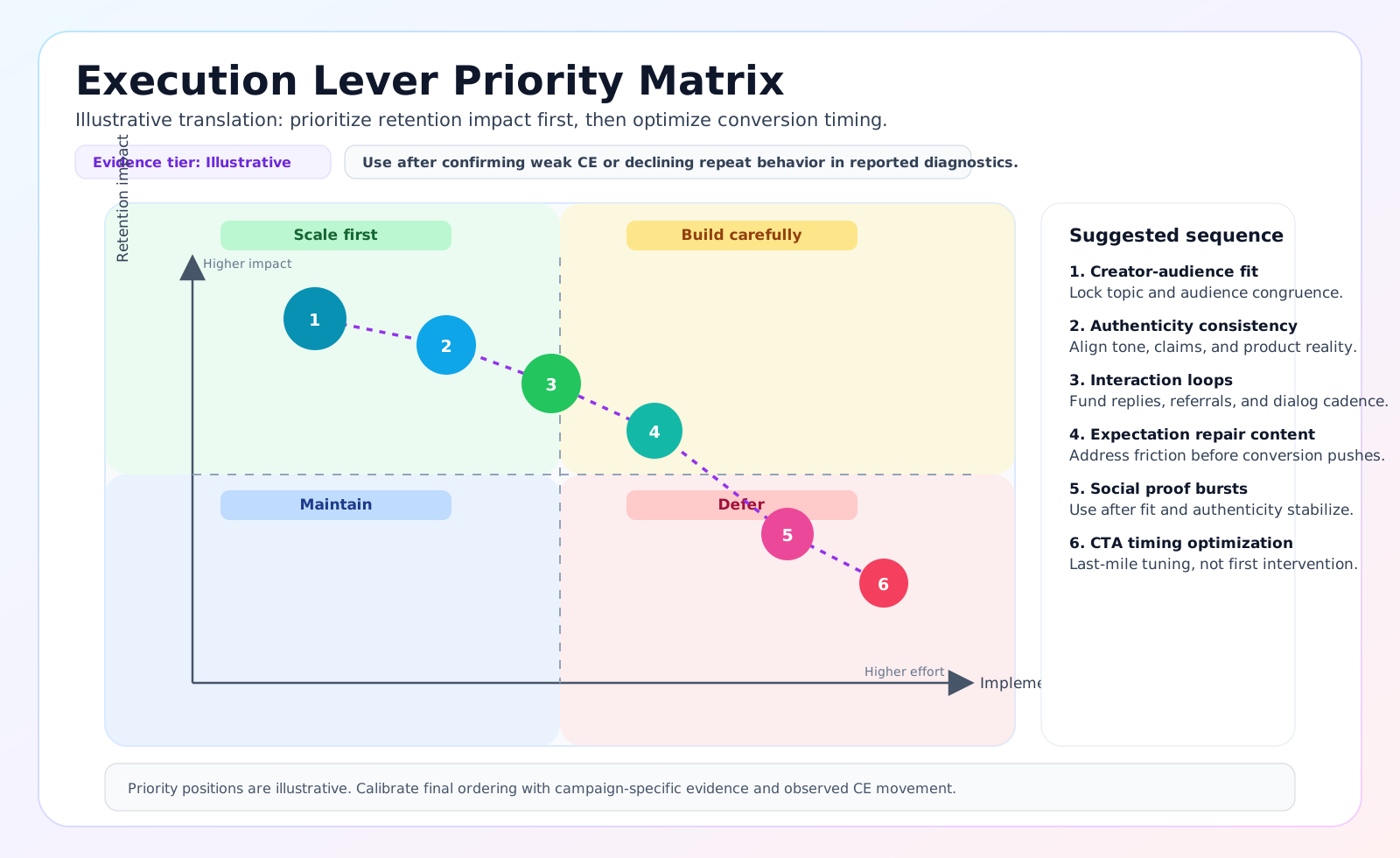
Illustrative execution matrix ranking creator fit authenticity interaction loops expectation repair social proof and CTA timing by impact and effort

Suggested sequence: fit -> authenticity -> interaction loops -> expectation repair -> social proof -> CTA timing.

Execution rule: repair trust and expectation gaps before scaling conversion-heavy tactics.

Right figure is an illustrative priority matrix that turns the reported signal pattern into action order.
Lab Protocol

How the study was run (five steps)

Step 1

Market and creator scoping

Defined the target group (active Vietnamese UGC users) and key creator categories.

Step 2

Influencer marketing construct design

Built survey items for CX, CEX, BE, CE, and CR, then checked measurement quality.

Step 3

Split-sample validation

Used EFA on n = 200 and CFA/SEM on n = 365 to test and validate model structure.

Step 4

Path and mediation testing

Estimated direct and mediated relationships to retention under influencer campaign conditions.

Step 5

Creator playbook translation

Converted model outputs into practical rules for targeting, messaging, and interaction design.

Influencer Marketing Playbook

What to do first when retention is weak

Start with interaction quality and expectation repair before buying broader reach.

Prioritize creator fit over creator volume

Scale only after authenticity and audience-fit remain stable.

Fund interaction quality before paid reach

Prioritize comment loops, referral support, and participation mechanics.

Repair expectation gaps before conversion pushes

Use proof-based content and message-product alignment before conversion bursts.

Recommended order: fit -> interaction quality -> expectation repair -> conversion scaling.